


Dr. Arunkumar Bongale
M.Tech., Ph.D.,
Professor & Head,
Robotic and Automation program
The global industrial landscape is undergoing a profound transformation driven by the Fourth Industrial Revolution, widely known as Industry 4.0. This new era is characterized by the seamless integration of digital technologies with physical systems through the Internet of Things (IoT), real-time data analytics, and cyber-physical systems. Such interconnectivity enables intelligent communication across processes, departments, partners, and stakeholders, empowering organizations to enhance operational visibility, improve decision-making, and achieve higher productivity and sustainable growth.
Among the core pillars of this revolution, robotics and automation play a pivotal role. From smart manufacturing and precision assembly to healthcare support and advanced service applications, robotic systems have significantly enhanced efficiency, accuracy, and safety across diverse sectors. Consequently, the demand for highly skilled, multidisciplinary professionals in this domain has grown exponentially.
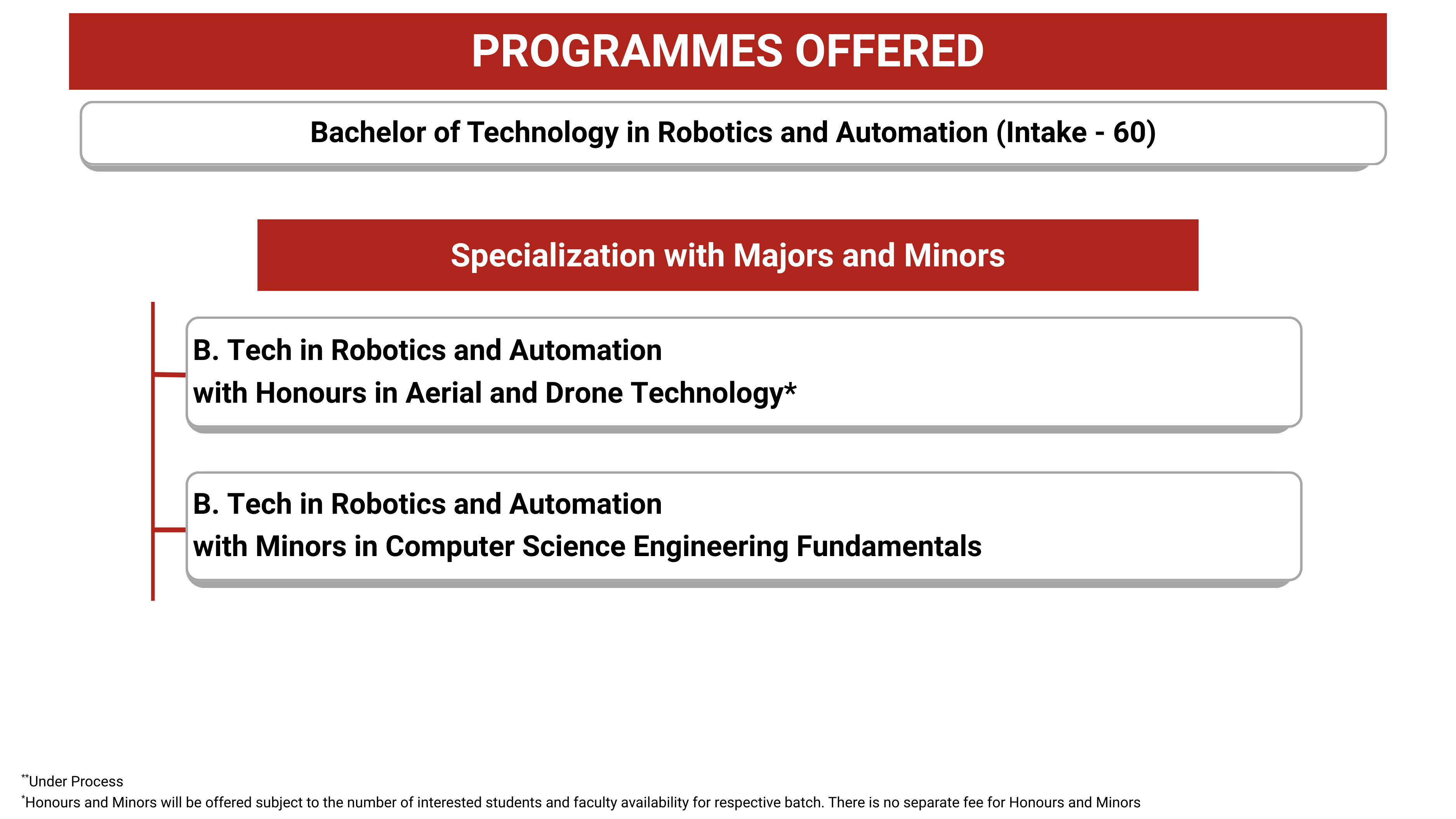
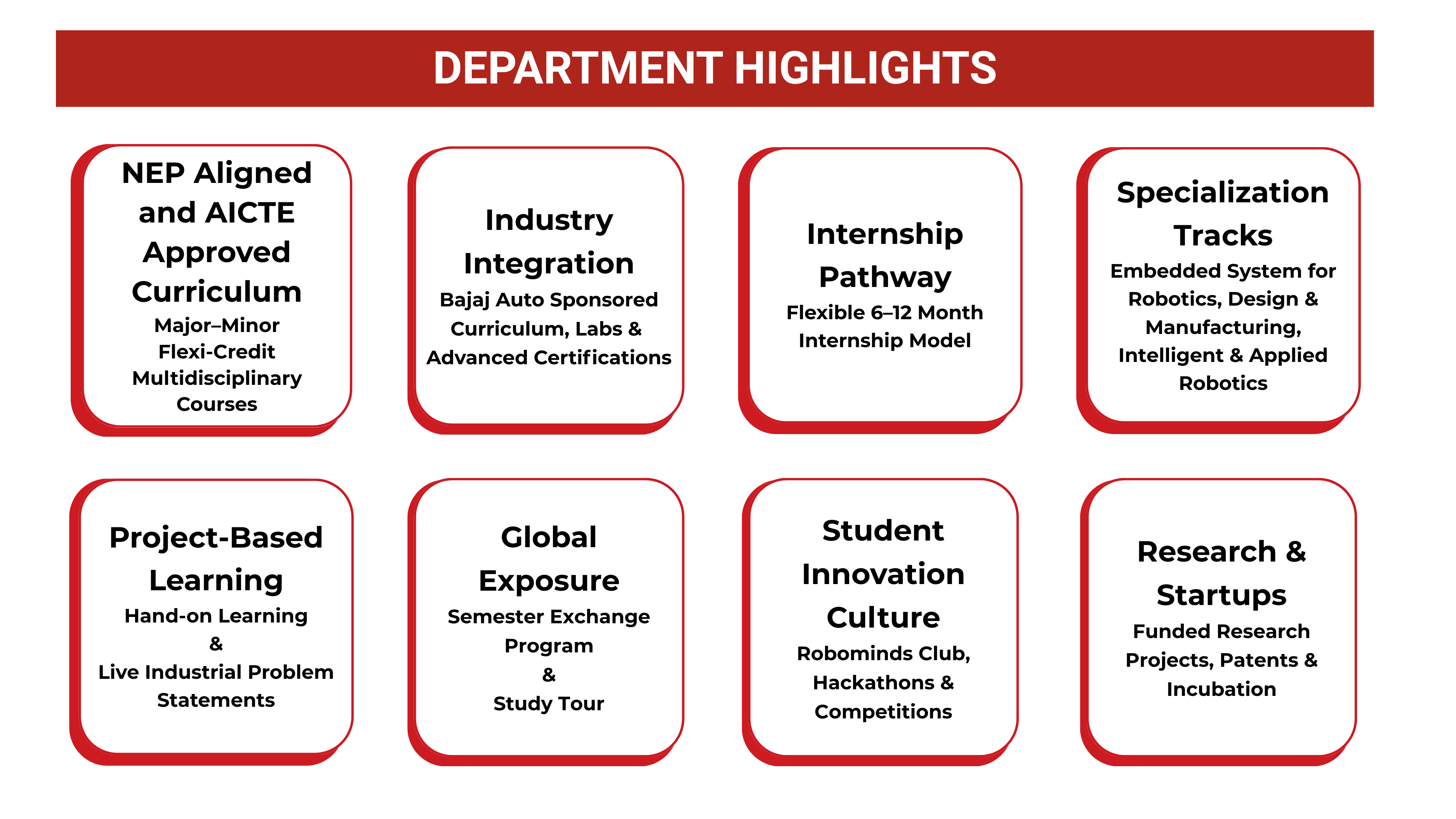
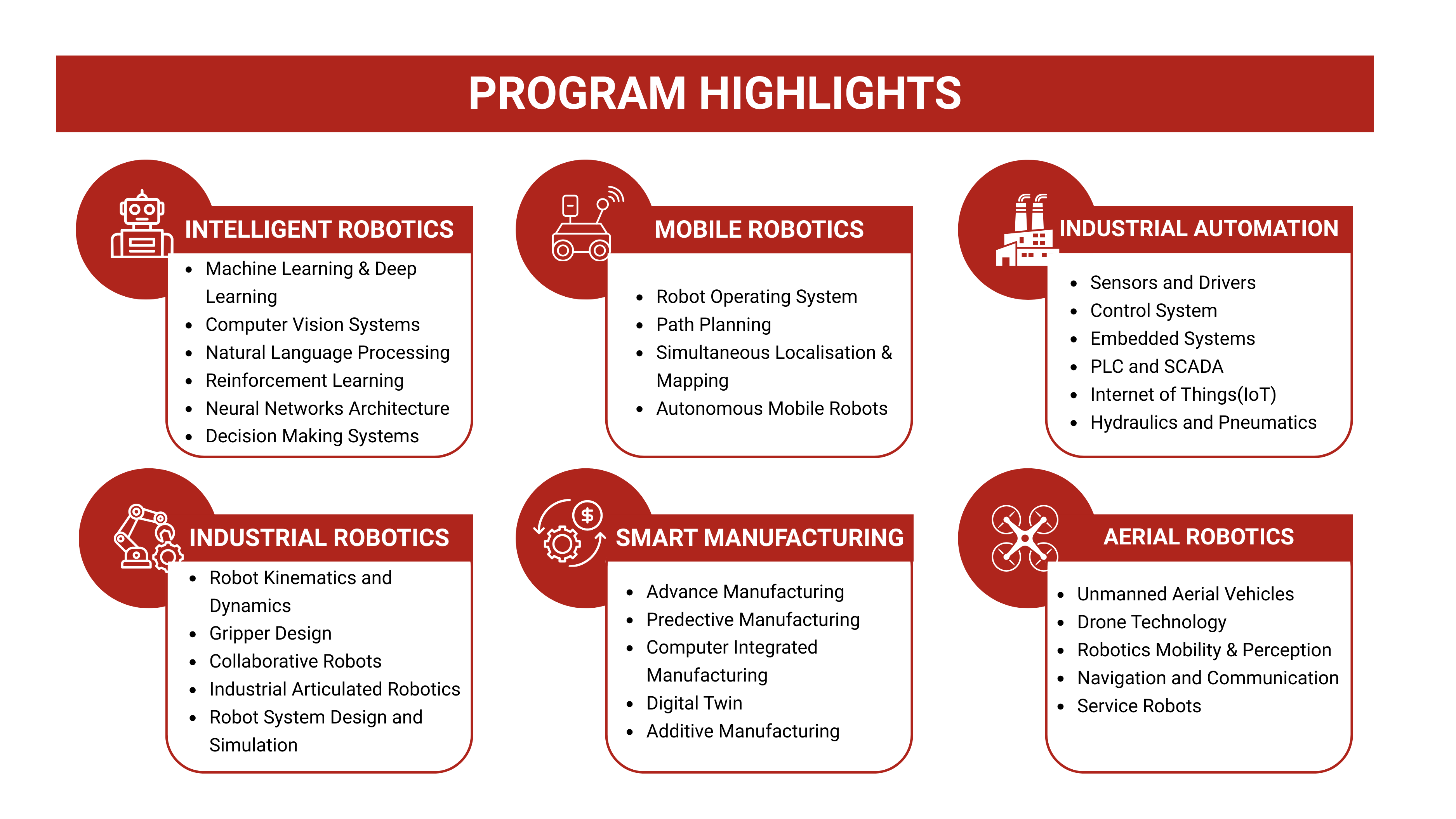
In alignment with these evolving industry requirements, the B. Tech program in Robotics and Automation is designed to develop future-ready engineers equipped with strong technical foundations, interdisciplinary expertise, and practical competencies aligned with Industry 4.0 standards. The program aims to prepare graduates to meet the dynamic needs of modern industries and to contribute effectively to technological innovation and industrial advancement.
| Program Educational Objectives (PEOs) | |
|---|---|
| PEO1 | Will gain the necessary knowledge to deliver innovative and state-of-the-art solutions for complex problems in automation, robotics and cross disciplinary domains |
| PEO2 | Will be part of diverse and multi-disciplinary teams and possess leadership skills, ethical values, social & environmental awareness. |
| PEO3 | Will be innovative and well equipped with advanced tools & techniques to develop and implement diverse products and services in the field of engineering through strong communication, interpersonal, and entrepreneurial skills. |
| PEO4 | Will have an attitude of life-long learning and pursue professional development opportunities to adapt to the ever-changing global economic and technological scenarios. |
| Program Outcomes (PO): | |
|---|---|
| PO 1 | Engineering knowledge: Apply the knowledge of mathematics, science, engineering fundamentals, and an engineering specialization to the solution of complex engineering problems. |
| PO 2 | Problem analysis: Identify, formulate, review research literature, and analyze complex engineering problems reaching substantiated conclusions using first principles of mathematics, natural sciences, and engineering sciences. |
| PO 3 | Design/development of solutions: Design solutions for complex engineering problems and design system components or processes that meet the specified needs with appropriate consideration for the public health and safety, and the cultural, societal, and environmental considerations. |
| PO 4 | Conduct investigations of complex problems: Use research-based knowledge and research methods including design of experiments, analysis and interpretation of data, and synthesis of the information to provide valid conclusions. |
| PO 5 | Modern tool usage: Create, select, and apply appropriate techniques, resources, and modern engineering and IT tools including prediction and modelling to complex engineering activities with an understanding of the limitations. |
| PO 6 | The engineer and society: Apply reasoning informed by the contextual knowledge to assess societal, health, safety, legal and cultural issues and the consequent responsibilities relevant to the professional engineering practice. |
| PO 7 | Environment and sustainability: Understand the impact of the professional engineering solutions in societal and environmental contexts, and demonstrate the knowledge of, and need for sustainable development. |
| PO 8 | Ethics: Apply ethical principles and commit to professional ethics and responsibilities and norms of the engineering practice. |
| PO 9 | Individual and team work: Function effectively as an individual, and as a member or leader in diverse teams, and in multidisciplinary settings. |
| PO 10 | Communication: Communicate effectively on complex engineering activities with the engineering community and with society at large, such as, being able to comprehend and write effective reports and design documentation, make effective presentations, and give and receive clear instructions. |
| PO 11 | Project management and finance: Demonstrate knowledge and understanding of the engineering and management principles and apply these to one’s own work, as a member and leader in a team, to manage projects and in multidisciplinary environments. |
| PO 12 | Life-long learning: Recognize the need for, and have the preparation and ability to engage in independent and life-long learning in the broadest context of technological change |
| Program Specific Outcomes (PSO): | |
|---|---|
| PSO 1 | An ability to apply interdisciplinary technical knowledge to design and implement complex systems to solve engineering problems in Industry 4.0 domain. |
| PSO 2 | An ability to make use of acquired technical knowledge for a successful career, research and entrepreneurship in the areas like robotics, automation, Internet of Things, Artificial Intelligence and Machine Learning. |


.jpg)
.jpg)
.jpg)
.jpg)
.jpg)
.jpg)
.jpg)
.jpg)
.png)
.png)
.png)
.png)
.png)
.jpg)
.jpg)
.jpg)
Dr Nikhil Deshpande, Associate Professor, Robotics & AI, Faculty of Sciences, Engineering and Technology, University of Nottingham, UK during visited department of R&A on 16th July, 2024. Interaction with the department faculties for possible collaborations in terms of joint research and student exchange was discussed along with the NEP implementation.
.jpg)
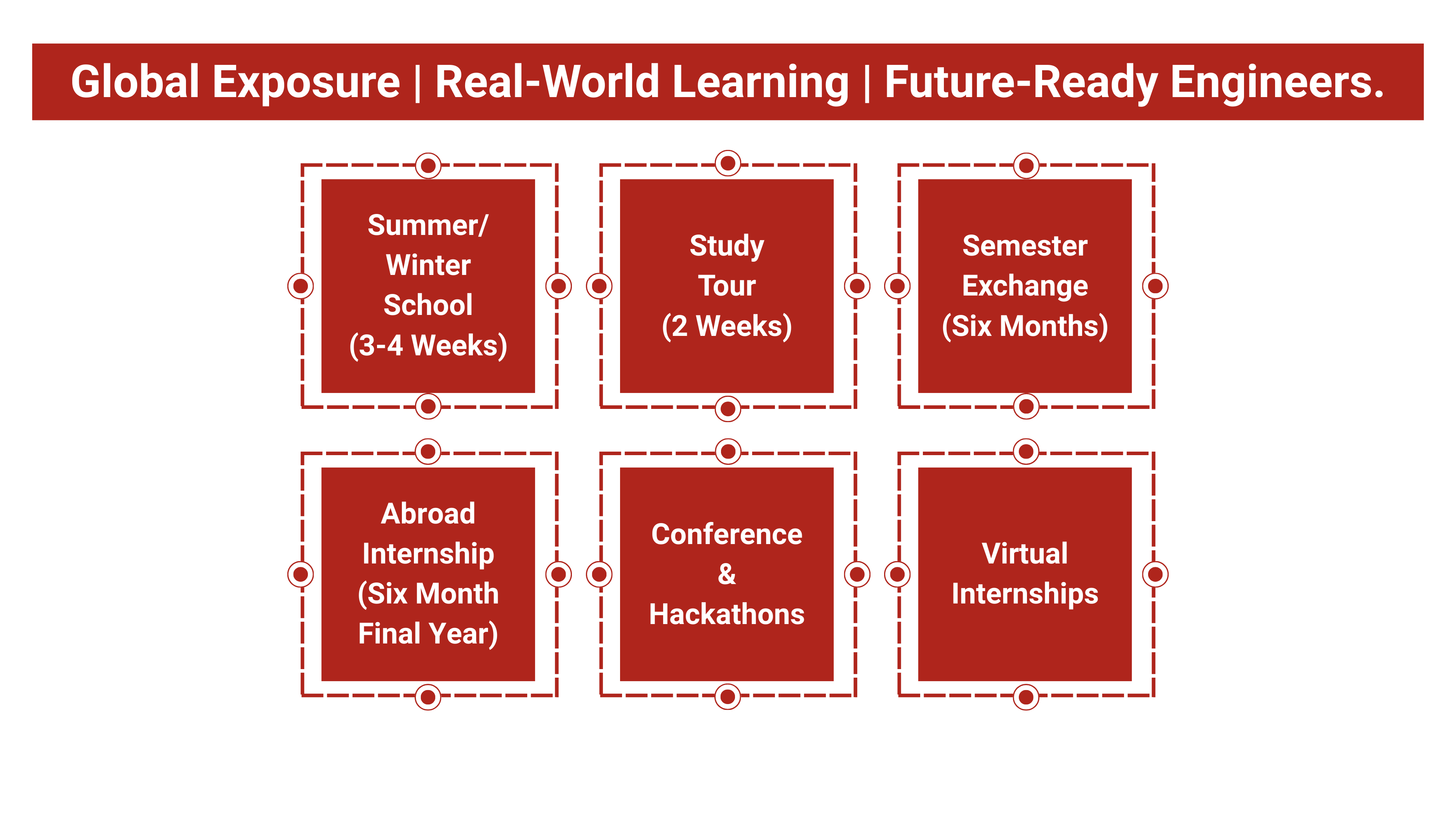
Students from the Third Year Robotics and Automation program recently embarked on a study tour to Japan arranged by International cell SIT. They visited Chiba University.
.png)
.jpg)
The team Robominds from the Department successfully cleared Stage 1 of DD Robocon - the national stage of the prestigious ABU Robocon 2026, with a score of 90 out of 100.
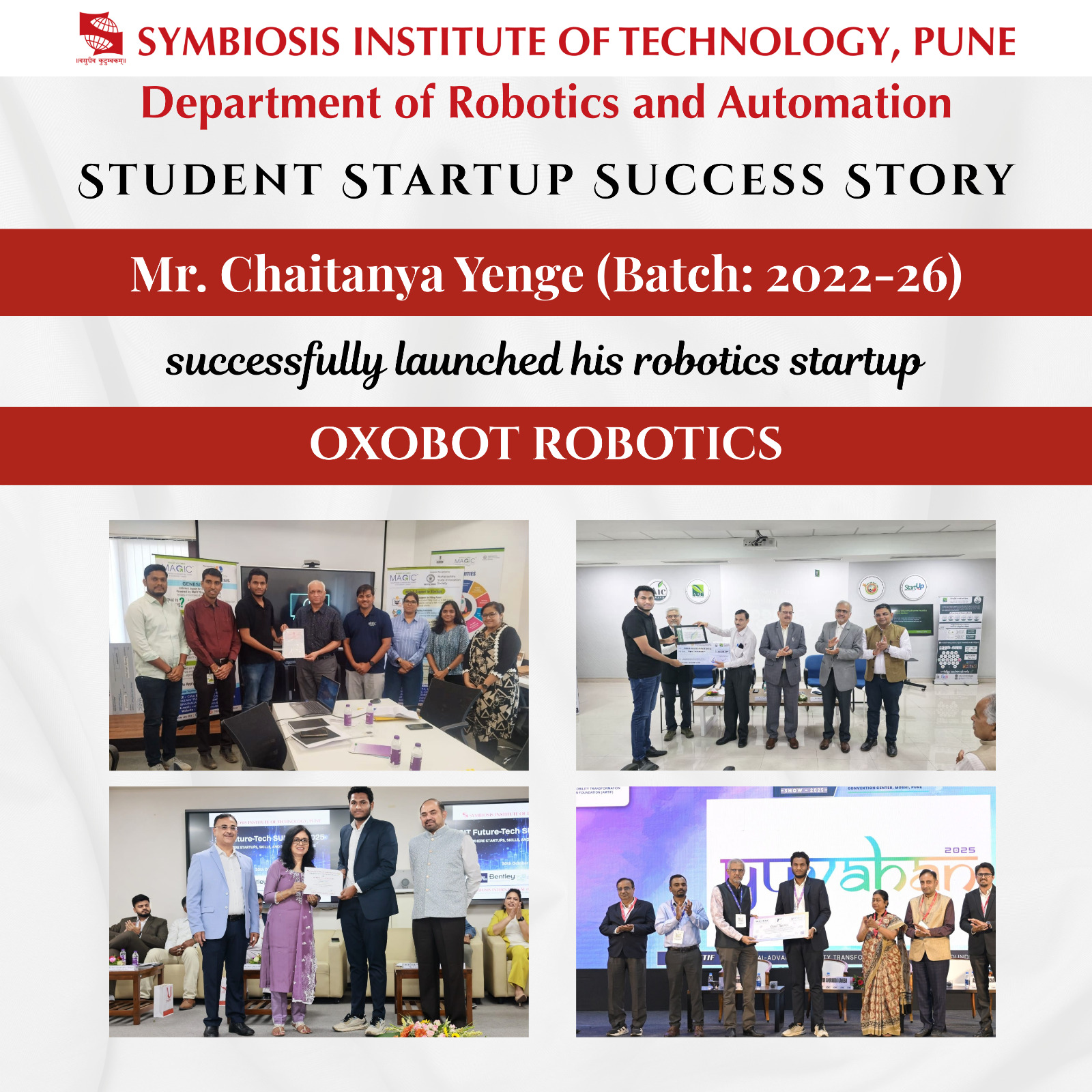
Chaitanya Yange, a B.Tech student of Batch: 2022-26 in Robotics & Automation, has founded the startup OXOBOT Robotics and secured ₹10 lakh in funding under the prestigious GENESIS EIR Grant Program at the MAGIC Business Incubator, Chhatrapati Sambhajinagar. The startup has also received support through the Innovation & Agri-Entrepreneurship Programme (PKVY), Ministry of Agriculture & Farmers Welfare, Government of India, and was recognised as the winner among 3,000+ entries at the ARAI–AMTIF–CII NexGen Mobility Startup & Innovation Conclave 2025.
.png)
.png)
.png)
A team of our students consisting of Yash Pund, Saachi Parmar, Rahul Kumar, and Utkarsh Kumar has achieved a notable milestone by securing the second round victory in the prestigious ROBOFEST competition. As a token of this significant achievement, the team has been awarded a cash prize of INR 2.50 Lakhs.
.png)
Congratulations to Paranjay N B from the Department of Robotics and Automation (2021-25 Batch) student for the Excellent achievements in the sports
.png)
Congratulations to Sadhana Sharma, a third-year Robotics and Automation student, for her integral role in the winning team of the 'Mission Ctrl' hackathon, hosted by FlytBase
| Program Name | Eligibility | Mandatory Courses at 10 +2 level | Other relevant course(s) for this discipline |
| B.Tech First Year Indian Students |
Passed 10+2 examination with Physics, Chemistry and Mathematics as compulsory subjects
Obtained at least 45% marks (40% marks in case of candidates belonging to reserved category) in the above subjects taken together. OR Passed D.Voc. Stream in the same or allied sector. (The University will offer suitable bridge courses such as Mathematics, Physics, Engineering drawing, etc., for the students coming from diverse backgrounds to prepare Level playing field and desired learning outcomes of the programme) |
Physics , Chemistry, Maths | Not Applicable |
| B.Tech First Year International Students |
International Students' eligibility as per SCIE norms. Please follow link www.scie.ac.in |
||
| Lateral Entry | Passed Minimum THREE years/ TWO year (Lateral Entry) Diploma examination with at least 45% marks (40% marks in case of candidates belonging to reserved category) in ANY branch of Engineering and Technology.
OR Passed B.Sc. Degree from a recognized University as defined by UGC, with at least 45% marks (40% marks in case of candidates belonging to reserved category) and passed 10+2 examination with Mathematics as a subject. OR Passed B. Voc/3 –year D.Voc. Stream in the same or allied sector. (The University will offer suitable bridge courses such as Mathematics, Physics, Engineering drawing, etc., for the students coming from diverse backgrounds to achieve desired learning outcomes of the program) |
||
| Reservation Policy for all program | ||||
| I. Within the sanctioned intake | a) SC (In Percentage) | b) ST (In Percentage) | c) Person with Disability (PwD) (In Percentage) | d) NRI (In Percentage) |
| 15 | 7.5 | 3 | 5 | |
| II. Over and above the sanctioned intake | a) Kashmiri Migrants (In Seats with a maximum of 10 seats in the Institute) | b) Foreign National /Overseas Citizen of India /children of the Indian Workers in the Gulf countries. (In percentage per course | ||
| 2 | 15 | |||
* Subject to AICTE guidelines.
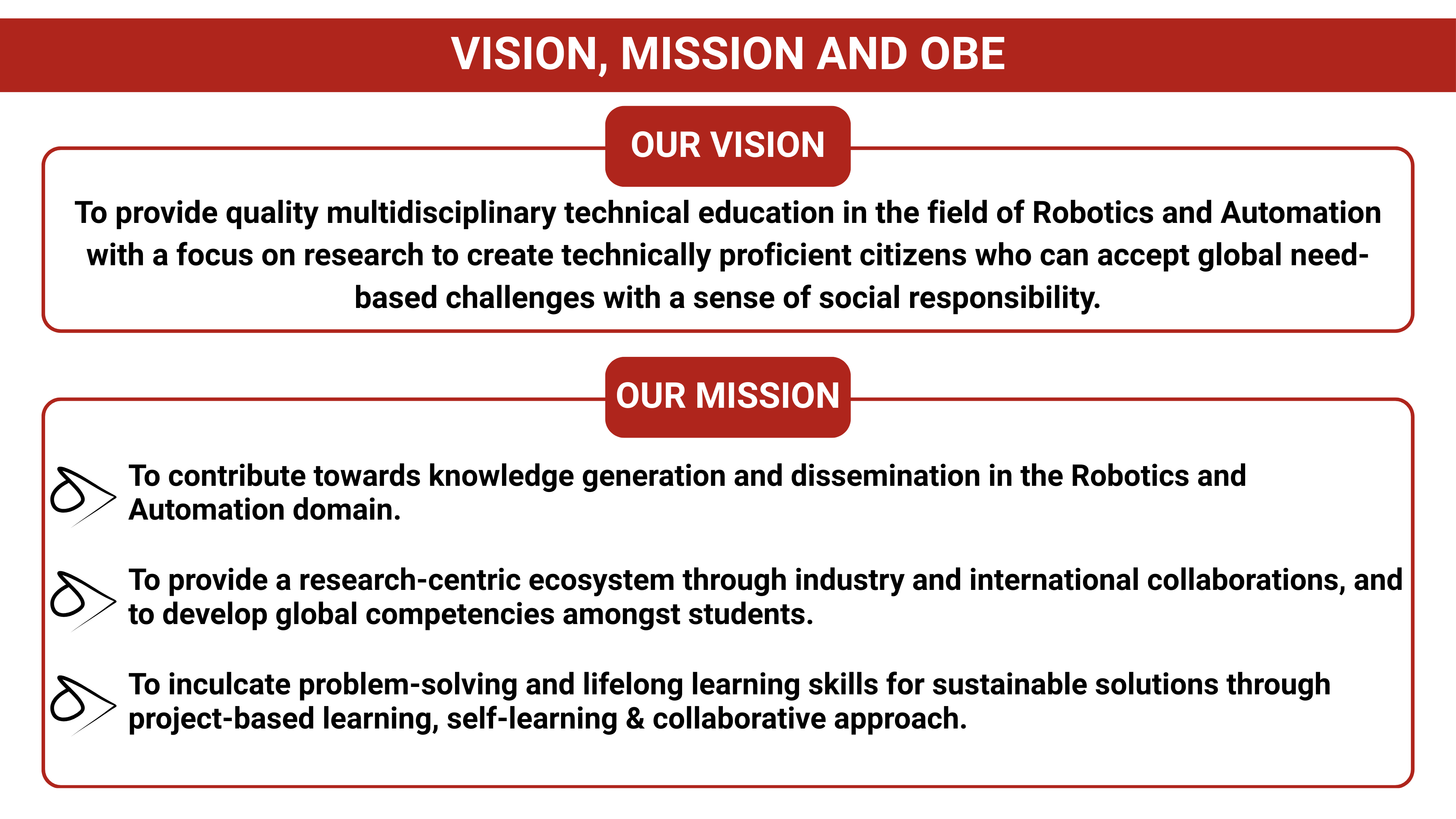
To provide quality multidisciplinary technical education in the field of Robotics
and Automation with a focus on research to create technically proficient citizens
who can accept global need-based challenges with a sense of social
responsibility.
M1- To contribute towards knowledge generation and dissemination in the Robotics and Automation domain.
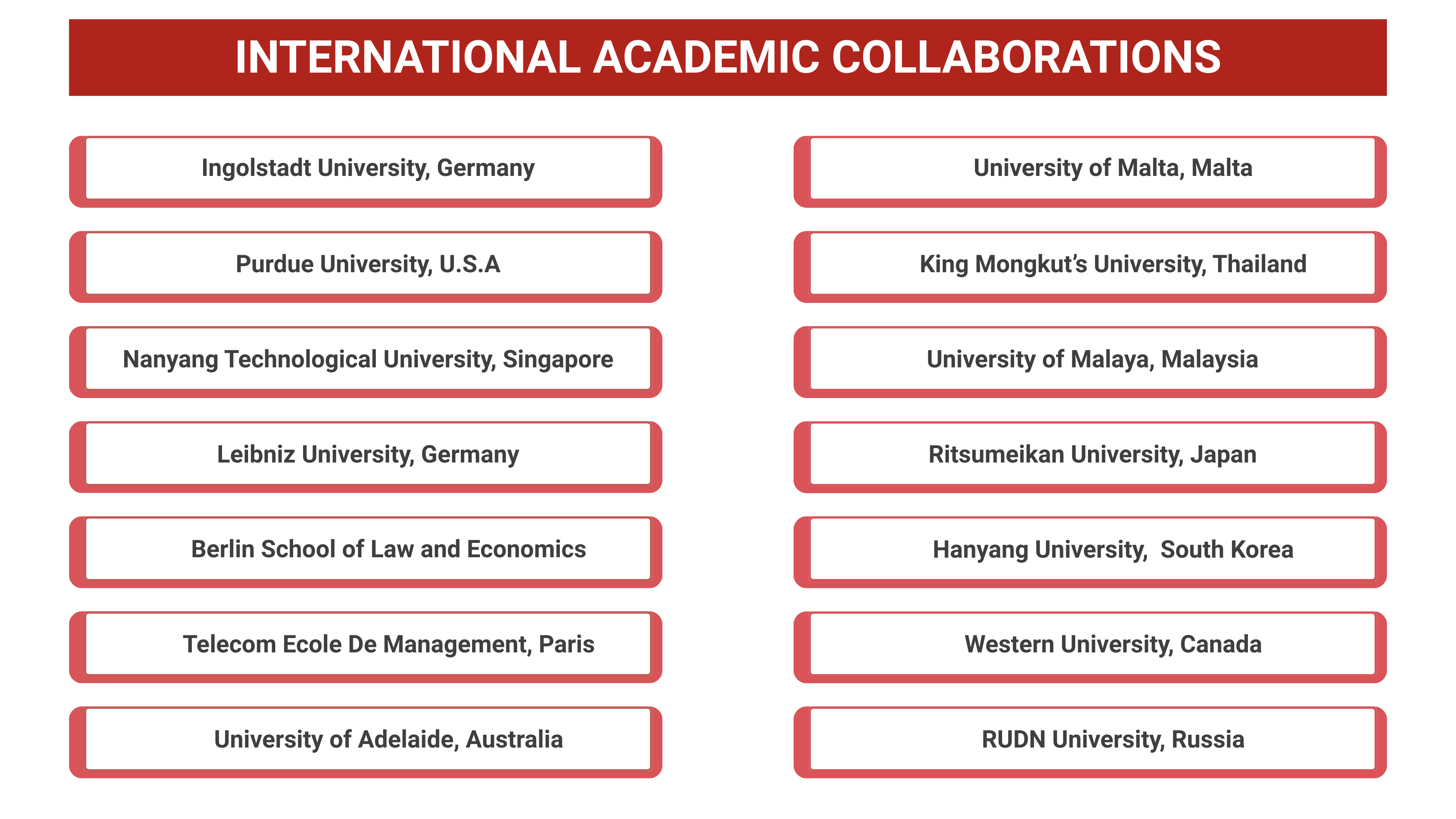
M2- To provide a research-centric ecosystem through industry and international collaborations and to develop global competencies amongst students.
M3- To inculcate problem-solving and lifelong learning skills for sustainable
solutions through project-based learning, self-learning & collaborative
approach.
PSO1:- An ability to apply interdisciplinary technical knowledge to design and implement complex systems to solve engineering problems in Industry 4.0 domain.
PSO2:- An ability to make use of acquired technical knowledge for a successful career, research and entrepreneurship in the areas like robotics, automation, Internet of Things, Artificial Intelligence and Machine Learning.
GA 1- Scholarship: research, inquiry and lifelong learning.
GA 2- Global citizenship: ethical, social and professional understanding.
GA 3- Eco-literate: sensitivity towards a sustainable environment.
GA 4- Employability: equipped with skills, attributes, leadership and entrepreneurial qualities that society needs; being capable of making a contribution to society through earning a living.


Symbiosis Institute of Technology (SIT) Pune and Indian Institute of Technology Bombay (IIT Bombay), in collaboration with FlytBase Labs, Pune, are proud to present a two-day workshop on Automated Drones for Commercial Applications. The workshop held on December 13-14, 2023, at the Robotics and Automation Department, SIT Pune
This comprehensive workshop, jointly conducted by MEItY, IIT Bombay, and SIT Pune, will equip you with the knowledge and skills to navigate the ever-evolving world of automated drones. Dive into the latest advancements, delve into real-world applications, and gain hands-on experience with a variety of automated drones.


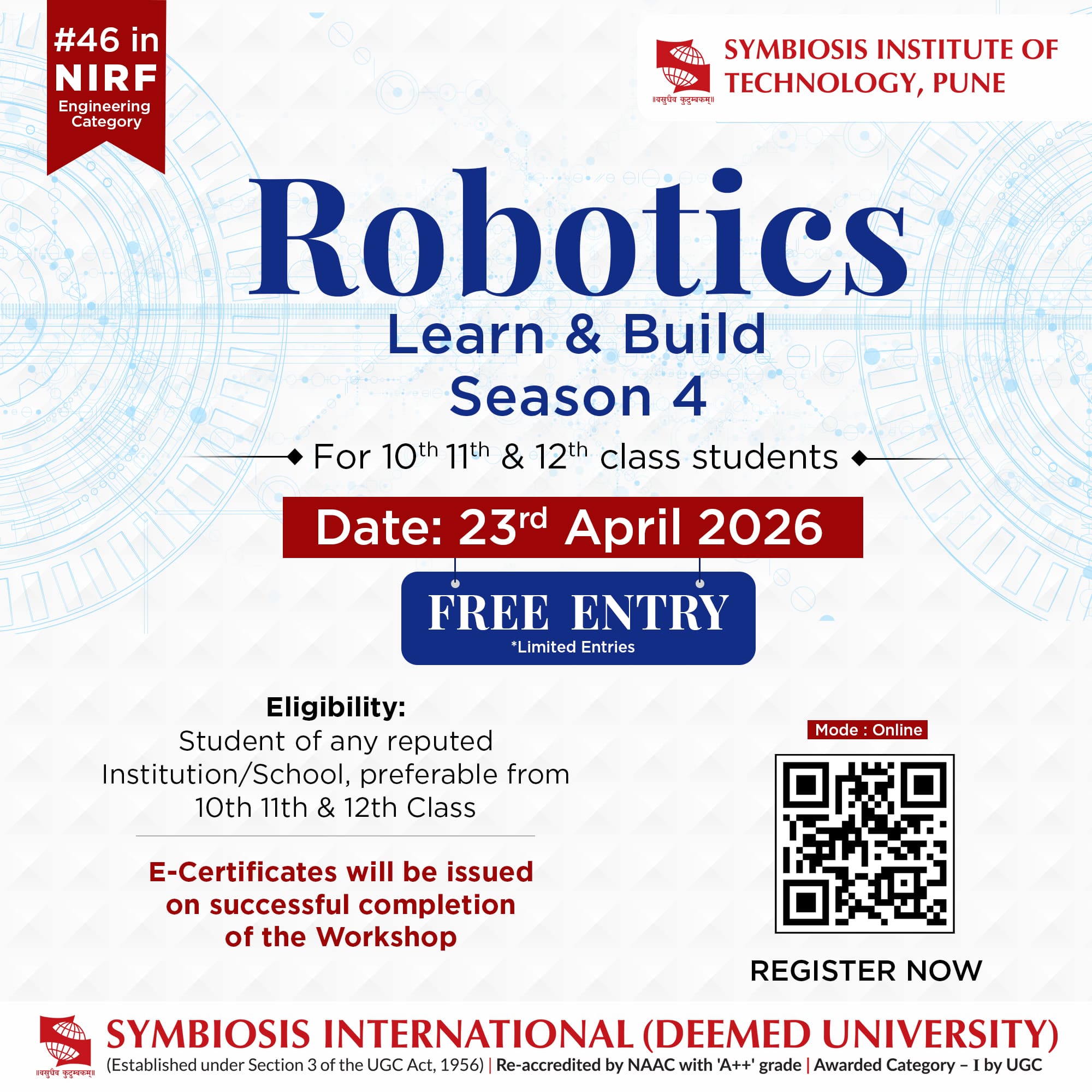
An engaging FREE online workshop by Department of Robotics and Automation at Symbiosis Institute of Technology, Pune designed for 10th, 11th & 12th students to explore the fundamentals of robotics, coding, and Arduino through hands-on learning.
Highlights:
Registration Link: https://lnkd.in/dfPeCmJf
(Limited seats – register early)
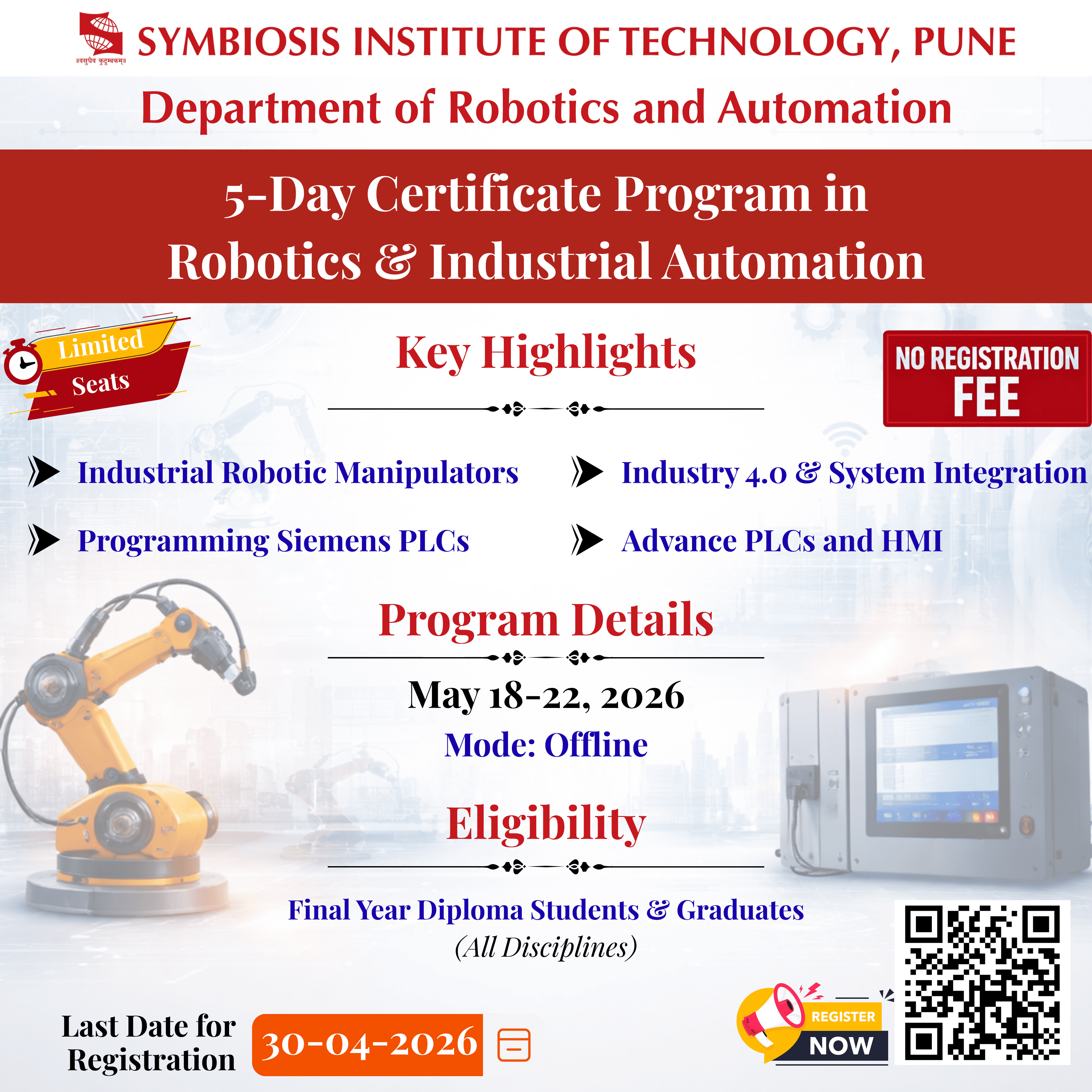
5-Day Certificate Program in Robotics & Industrial Automation
A hands-on, industry-focused certification program by the Department of Robotics & Automation, Symbiosis Institute of Technology, Pune, designed to equip students with practical skills in industrial robotics, PLC programming, and Industry 4.0 technologies.
Registration Link:
Register Here
(Limited seats – early registration recommended)
We're excited to announce the new season of our 2-day Robotics Learn & Build workshop for students in grades 9th-12th! This workshop is designed to teach students the basics of robotics and provide hands-on experience in building their own robots.
In this workshop,
students will learn about the different
components of a robot and how they work
together to create a functioning machine.
They will also learn about programming and
how it is used to control robots. Through
practical activities, students will gain
skills in designing, constructing, and
programming robots. Registration is now
open, and spaces are limited, so register
early to secure your spot! For more
information about the workshop and to
register!

Robotics is the art of making robots, machines that combine concepts from multiple engineering disciplines. Join us to learn Robotics by practically building your own robot.
SIT Pune brings to you a fantastic 2-day workshop for the students of 9th, 10th, 11th & 12th: Robotics - Learn & Build. Grasp the fundamental concepts of Robotics via practical application. Participants will be certified after the successful completion of workshop! So, get set, register for this wonderful opportunity.

Robotics is the art of making robots, machines that combine concepts from multiple engineering disciplines. Join us to learn Robotics by practically building your own robot.
SIT brings to you a fantastic 4-day workshop for the students of 11th & 12th: Robotics - Learn & Build. Grasp the fundamental concepts of Robotics via practical application. Participants will be certified by AICRA after the successful completion of workshop! So, get set, register for this wonderful opportunity.
.jpg)
SIT has conducted a Introductory Session on "Robotics - Build & Learn" to various schools to give a glimpses of the workshop. Check out the same using the link below.
Our B.Tech and M.Tech Robotics and Automation students successfully completed an industrial visit to Wipro PARI, gaining hands-on exposure to advanced robotics, automation, and smart manufacturing systems. The visit bridged the gap between academic learning and industry practices while enabling valuable interactions with experts on emerging technologies and career opportunities.
.jpg)
The Department of Robotics and Automation organized an enriching industrial visit for fifth-semester B. Tech (2022-26 Batch) and first-semester M. Tech students (2024-26 Batch) to Wipro PARI robotics on 14th September 2024. This visit was planned to provide students with an immersive experience in the field of robotics and automation technologies.
.png)
Visit to Vitesco Technologies

The Department of Robotics and Automation organized an Industrial Visit to Analogic Automation Pvt. Ltd., Pune on 03rd February 2023 for B. Tech (2021-25) and M. Tech (2022-2024) students to understand the underlying principles of industrial automation in the Food and Beverages Industry.


Assessment of B Tech Projects was conducted by Industry Experts for the batch 2021-25.
As part of our ongoing efforts to bridge the gap between academia and industry, we successfully conducted an innovative evaluation strategy for B. Tech projects for the batch 2021-25 on 15th and 16th November, 2024. This initiative brought together industry experts to assess the students' projects, providing valuable real-world insights and feedback. The evaluation panel included distinguished professionals such as Mr. Sudin Baraokar, Mr. Anand Muglikar, Mr. Amit Sarode, Mr. Vishal Kondalkar , Mr. Abhijit Undre, Mr. Kunal Kolte, Mr. Vageesh G.P. Their expertise and constructive critique not only highlighted the students' strengths but also offered guidance on how to refine and enhance their projects for greater industry relevance.
Industry Co-Teaching
A value added course on Advanced Machine Learning with Python is arranged from 21st October 2024 (Monday). This course aims to enhance your skills and knowledge in key areas of Python programming and Machine Learning, which are essential for your academic and professional growth.
The course will be delivered by Mr. Pranav Gandhi, an Industry Expert having 23+ years of experience and will be fully industry oriented.
Important details:
Course Duration: 21st - 24th October 2024 (9:00 AM - 4:00 PM) followed by 2 days of Project work.
Course Title: Advanced Machine Learning with Python
.png)
Value Added Course
6-Day AR/VR Training Program
We have arranged and conducted a 6-day training program on Augmented Reality (AR) and Virtual Reality (VR) technology. This program is designed to provide hands-on experience and in-depth knowledge about the latest trends and applications in AR and VR.
Details of the Training:
Dates: 2nd, 4th, 5th, 6th, 9th and 10th September 2024
Time: 8:45 AM to 4:30 PM
Venue: PLC & Automation Lab, 6th Floor
.png)
Workshop on Aptitude Training
The department had planned a workshop on Aptitude Training focusing on the following aspects. The training was scheduled for 13th September, 2024.
Importance of Aptitude: Understand why aptitude is crucial for campus recruitment.
Placement Exams Overview: Gain insights into leading exams like TCS NQT, Wipro Elite, eLitmus.
Getting Started: A beginner's guide to starting aptitude preparation.
Practice Questions: Practice with sample questions to build a strong foundation.
Conquering Campus Placement: Holistic preparation tips combining aptitude, soft skills, and coding.
.jpg)
Two days Workshop on Python and SQL is arranged for final year students from 26th and 27th August, 2024.
.jpg)
A hands-on co-teaching workshop on Programmable Logic Controllers (PLC) was conducted for third-year B. Tech Robotics and Automation students and first-year M. Tech students from March 24 to March 26, 2025, between 9:00 AM and 4:30 PM in association with Arun Jangam, Nayan Mechatronics. The workshop provided participants with practical exposure to industrial automation and control systems. The workshop began with fundamental concepts of PLCs and control systems, covering essential principles of basic electrical and electronics engineering. Participants were introduced to different PLC architectures and their applications in industrial automation. Hands-on sessions were conducted using Siemens and Mitsubishi PLCs, allowing students to gain experience in PLC programming and hardware interfacing. A key highlight of the workshop was the practical implementation of various input devices, such as push buttons, switches, and sensors, to control actuators in real-time. Through guided exercises, students learned how to design, program, and troubleshoot PLC-based automation systems.
.jpeg)
.jpeg)
.png)
Real-Time Object Detection for Blind Assistance
.png)
Automatic Number Plate Recognition System
.png)
Smart attendance system for multiface detection using Computer Vision
.png)
Collaborative Path Planning and Obstacle Avoidance for Autonomous TurtleBot Navigation
.png)


Robotics and automation are considered as one of the integral and significant parts of Industry 4.0. In the current era, automated machines like robots have turned out to be extremely beneficial for various sectors - starting from assisting humans around the house to industrial applications like assembling and packing products and helping doctors in performing complex surgeries. This new development has opened a door for enormous opportunities for the skilled and trained professionals.
In order to enhance the knowledge in the field of Robotics engineering, Symbiosis Institute of Technology has planned to organize several technical talks from various industry and academic experts. Interested students and industry professionals in the field of Robotics and automation engineering can make use of this opportunity and participate in all the tech talks series.


.jpg)

.jpg)
.jpg)
.jpg)
.jpg)
.jpg)
